What I've built

SEAN LAMBERT

Self-taught AI systems architect · Northern Virginia

I'm Sean Lambert. Since January 2026 I have designed, built, and run production LLM systems with Claude as the engineering interface — a media production engine and the evaluation layer that grades it, an always-on agent that runs my company's day, and paid client delivery. Before January I taught myself on Claude's free tier and kept none of the work; everything on this page comes from the eight months since. I build solo, I verify my own output before I show it, and every number here is one I can re-derive on request.

Production service live  ·  Platform in private beta  ·  Client work paid and in flight
Scroll

Numbers I can defend.

Every figure below maps to an artifact in a repository — a measured run, a signed approval, a credit award, a session ledger. Where a number got smaller under scrutiny, the smaller one is what's printed.

400+
craft facets in the measurement bank, computed on real footage
16
of my own evaluation checks caught unable to fail — found, root-caused, documented
2,200+
archived working sessions since January 2026
$8,600
AWS Activate and NVIDIA Inception credits applied for, won, and engineered against

A production engine that refuses its own output.

Production service live · Platform in private beta
The problem

Generative video got cheap; trusting it did not. You can produce fifty variants in an afternoon and still have no way to tell a good one from a merely plausible one — so a person has to watch everything, and human attention becomes the bottleneck the tooling was supposed to remove.

The architecture

SAGA is a conductor, not a renderer. Authored intent is compiled into shots; each shot is executed by whatever renders it best — deterministic code-rendered scenes, or a generative model driven by prompts translated per model and per shot; an evaluation layer then scores every beat against a human-curated reference across a 400+ facet measurement bank; and the result is handed out to a real editor's timeline (DaVinci / OTIO) instead of being locked in a black box. The build-vs-buy call was deliberate: drive real renderers, never write one. The model underneath is a swappable part, which is why a new one landing is an afternoon and not a rewrite.

One hard decision

The verdict layer does not average. The first version I built did: it took the facet scores and produced a mean. It always returned a reasonable-looking number and it never refused anything — which is exactly what a mean is for. It hides one catastrophic failure behind twenty acceptable ones.

I rebuilt it as conjunctive floors: worst-dominated, every floor binding, no composite score available by construction. It started refusing work, which was the point. I found the same non-averaging conclusion in the 2025–26 judge-panel literature afterwards — I arrived at it from the failure, not the paper, and that is the version I can defend line by line.

Testing whether a check can fail.

Internal validation harness · Runs continuously
The problem

A broken evaluation is worse than no evaluation. It runs, returns plausible numbers, and certifies everything you hand it — and you don't find out until you have already shipped on its say-so.

The architecture

Every check has to earn trust twice: a positive control it must reject — deliberately failing input — and a null control it must not separate. Around that sits corpus validation with provenance control: a professional reference corpus and a counter-corpus drawn from the same channel a decade apart, so a metric that separates them is reading craft and not source; an amateur production ladder that has to come out in monotonic order; and register controls, because broadcast norms and YouTube norms are different measuring sticks. Eighteen films across the two corpora, acquired and banked for under $2 of cloud credits.

One hard decision

Controls are built from real material, not clean material. My first positive control was lab-pure — synthetic, unambiguous — and the detector passed it. Then I ran the same detector against realistic failing footage and it was blind. The control had certified an instrument that could not see.

Sixteen checks turned out to be in that class: running, plausible, structurally unable to fail. Now I test whether a check can fail before I trust that it passed. It costs me claims — of the 400+ facets measured under provenance control, exactly one currently survives as an armed binding floor — and I would rather publish that number than a larger one I cannot defend.

An agent allowed to improve itself, under proof.

Built & running daily · Deployable for customers
The problem

The thing that actually matters — the lead, the grant, the reply that closes something — arrives buried. And a tool that only alerts you has just built you a second inbox to read.

The architecture

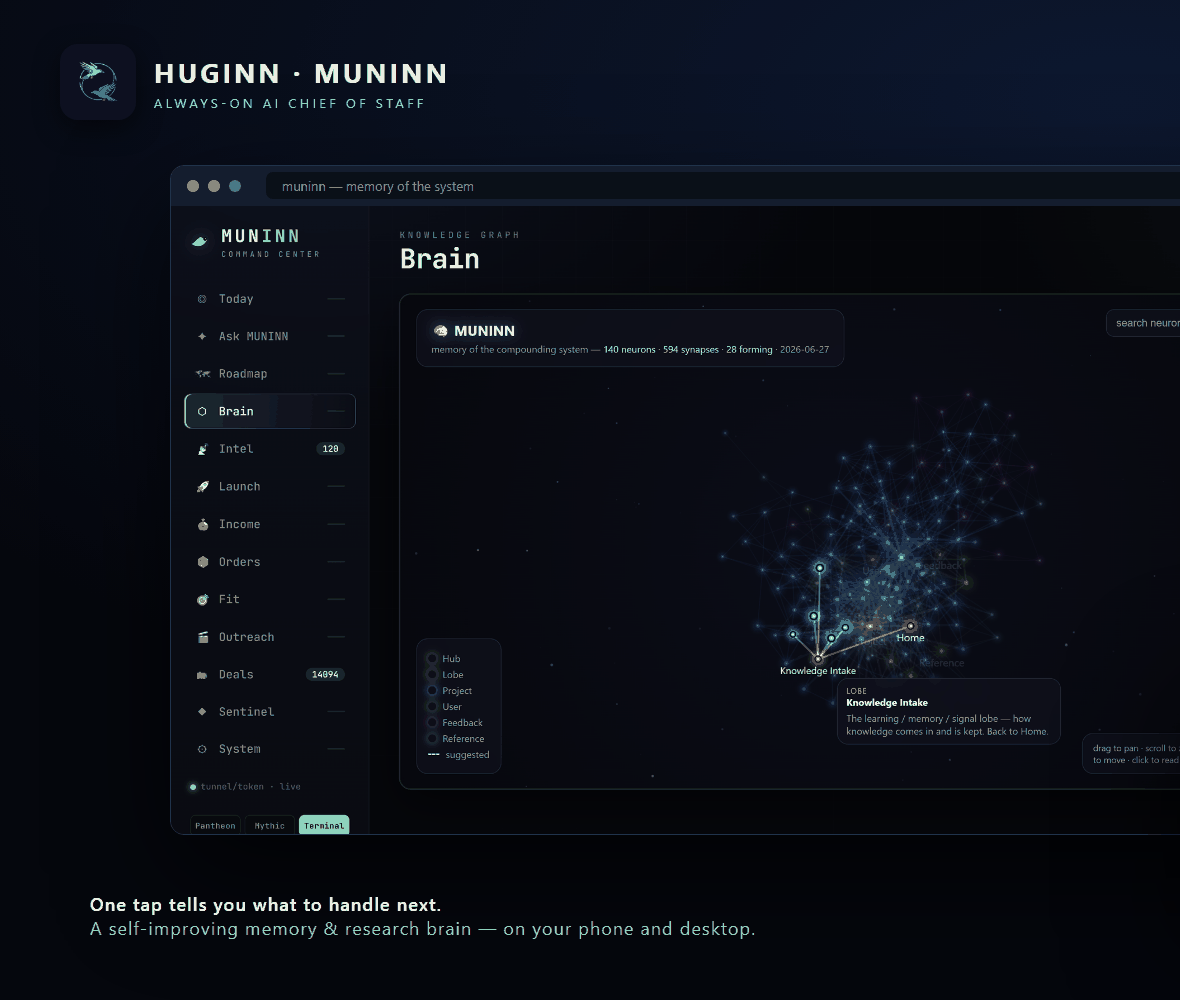
Scheduled agents sweep sources on a cadence and write into a knowledge-graph memory; a triage layer ranks what surfaced and drafts the response already filled out; a single "what's next" surface takes one tap on desktop or phone to approve, dismiss, or defer, and dismissals are training signal rather than noise. Nothing outbound sends without approval. It runs my own day — the same deployment I put into a customer's business, not a bespoke rebuild per client.

One hard decision

Self-improvement is gated on downstream verification, never on self-report. The system proposes its own upgrades, so the interesting question is what stops it accepting a bad one. The first version reported its own success — and I caught it reporting success for a job whose output never existed.

I named the class silent death and changed the rule: an improvement is accepted only when a downstream artifact verifies it, with the check reading the produced file rather than the agent's summary of itself. An agent's self-report is not evidence. Treating it as evidence is how an autonomous loop rots with nobody noticing.

A client's house rules, compiled into gates.

Paid production in flight · Client anonymised
The problem

A paying client had seven house rules about how their content must look and what it is allowed to claim. Requirements like that survive the first review cycle and then get violated on the fifth deliverable at 2am.

The architecture

The engagement ran end to end: discovery, a proof test, five rounds of structured feedback, a revised cut signed off on record ("much, much better… pretty perfect"), pricing proposed and accepted at $200 per video, then paid production. Their aesthetic notes became an explicit device specification. Their content rules became a rule registry in which the client's newest instruction is the tiebreaker — so there is always an answer to "which instruction won, and when."

One hard decision

Their requirements became executable gates, not a checklist. A render that occludes the subject's face, or makes a claim their compliance rule forbids, fails a gate and never reaches them — refused before I even see it.

A checklist depends on me being careful on the fifth deliverable at 2am; a gate does not care how tired I am. It is the same move as the evaluation work, pointed at a customer requirement: make the failure unconstructible instead of promising to watch for it.

Built with Claude — and mostly running on it.

Not a vague "AI-assisted." Here is exactly where the model sits in the systems above, and the discipline each position needed before it was trustworthy.

Orchestration

Claude Code is the engineering interface, not an autocomplete. Parallel sessions run with explicit file-ownership lanes — two drivers editing one file clobber each other, which I learned by losing an evening's work — and every session ends in a handoff written so a cold reader resumes with no re-derivation.

Sub-agent fan-out

Search and analysis go to sub-agents that return conclusions, not file dumps, so the orchestrating context stays clean and the expensive model keeps its attention for planning and judging. Cheap models do the labour. One canary unit runs before any batch.

Judge loops

Proposer, adversary, judge — run as an actual cycle, where the inner loop may declare saturation but the outer loop holds the only authority to stop. Vision-model judging is pairwise and reference-anchored, because I proved by experiment that absolute VLM scoring is prompt-suggestible: it drifts toward whatever the prompt implies.

Bedrock routing

Overflow from subscription capacity onto AWS Bedrock, with per-session model routing and inference profiles (us.anthropic.* rather than bare foundation ids — a gotcha that cost me a batch before I wrote it down), plus a billing canary before anything expensive runs.

Checkpointed, resumable jobs

Long jobs run detached, checkpointed, and idempotent. A rate limit, a crash, or a dropped connection re-spends nothing and reports exactly which unit was in flight — so "continue" means continue, not start over. Cost control and reliability turned out to be the same engineering problem.
Rendered, not promised.

Everything below came out of the systems described above. The code-rendered pieces are deterministic and reproducible: no generative model, no per-frame cost. The last one was produced by directing a generative model through SAGA, assembled from separately rendered beats.

The Huginn · Muninn command center: the day's brief over a knowledge-graph memory of 140 linked notes and 594 links

Huginn · Muninn, running. A screenshot of the live system, shown in a device frame.

The scope markers are literal.

Production service live means a customer pays for the output. Platform in private beta means it is not self-serve yet and I will not pretend otherwise. Built & running daily means I use it every day and it is not a demo. Where scrutiny has shrunk a claim, this page carries the shrunken one — that is the whole habit I would bring to helping someone else's team measure what their AI is actually doing.

Happy to walk through any of it.

Architecture decisions with the reasoning, evaluation methodology including the nulls and confounds, or the client cycle with the receipts — pick any one and I'll go as deep as you want. Northern Virginia, DC area, in person when it helps.

Email me